Guides to what electricity actually costs
The calculators answer "how much?". These explain the "why", so you can check our arithmetic against your own bill instead of taking it on trust.
Gas oven to electric: what changes on the bill
Swapping a gas oven for an electric one moves the cost from one utility to another. What that actually works out to, with the arithmetic shown.
How we calculate
The six usage models, why watts times hours is wrong for most appliances, and the limits of every figure on this site.
Electricity prices, and why the average is not your bill
The full rate table with its source and vintage, plus how to work out the only price that really matters — yours.
Watts, kilowatts and kilowatt-hours
A watt is a rate: how fast an appliance draws power at this instant. A kilowatt is a thousand of them. A kilowatt-hour is a quantity: one kilowatt drawn for one hour, and it is the thing you are billed for.
So a 1,500-watt heater is drawing 1.5 kW. Run it for four hours and it has used 1.5 × 4 = 6 kWh. At $0.1816/kWh that is $1.09. That is the entire calculation, and you can do it on any bill in your house.
The trap is the nameplate. A wattage on a label is usually the maximum draw, and many appliances spend most of their time well below it — or, like a fridge, switched off entirely for two thirds of the day. That gap between rated power and actual use is where most published running-cost figures go wrong, and it is why each appliance here is costed with a model that matches how it is used.
Finding the price you actually pay
Your utility's advertised rate is rarely the number you want. Take a recent bill, find the total amount charged and the kilowatt-hours used in the same period, and divide one by the other. The result includes the fixed charges, taxes and adjustments that a headline rate leaves out, and it is the figure to type into any calculator on this site.
If your plan has time-of-use pricing, do this twice — once for the peak window and once for off-peak — and use whichever applies to when the appliance actually runs. For EV charging that distinction is usually the largest single lever on the cost.
What is worth measuring
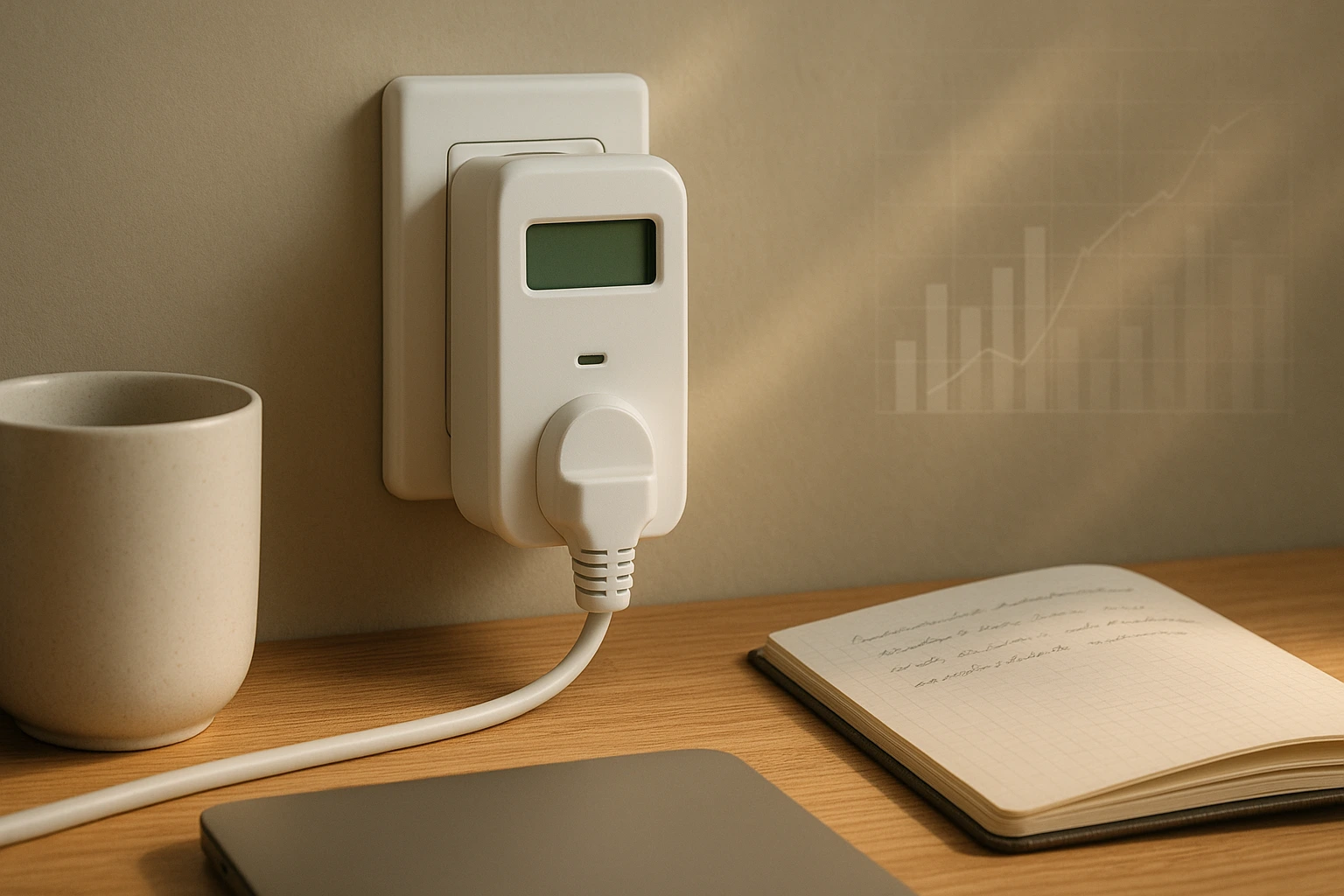
A plug-in energy meter costs very little and settles arguments: it reports the actual kilowatt-hours an appliance used over a week, which beats every typical figure including ours. It is the right tool for anything that cycles, idles or has a standby draw — fridges, freezers, entertainment setups, aquariums, anything with a transformer. It cannot be used on a hard-wired load such as central heating, an electric furnace, a water heater or an EV charger; those need a whole-home monitor installed at the panel by an electrician.
Start calculating
Measure before you optimize
More measure before you optimize

Practical home-energy choices
More practical home-energy choices